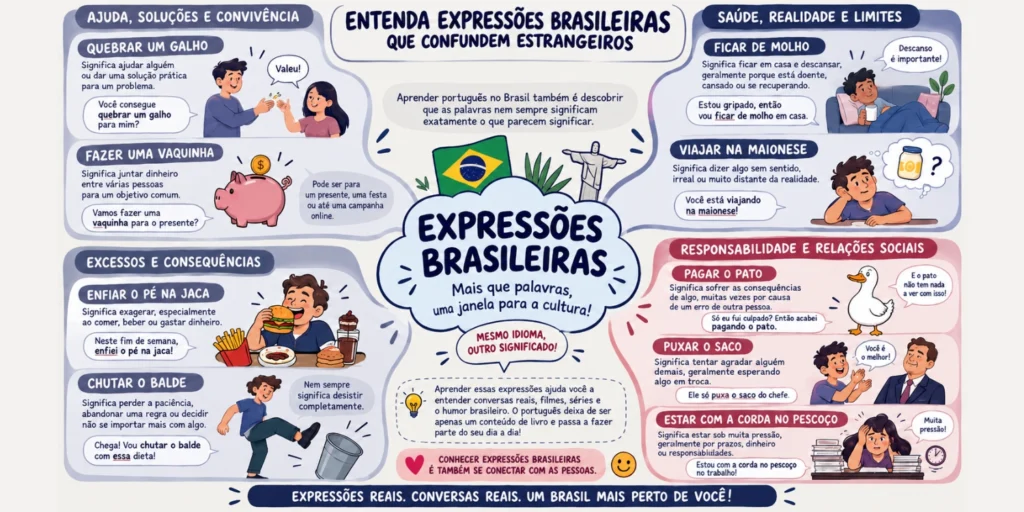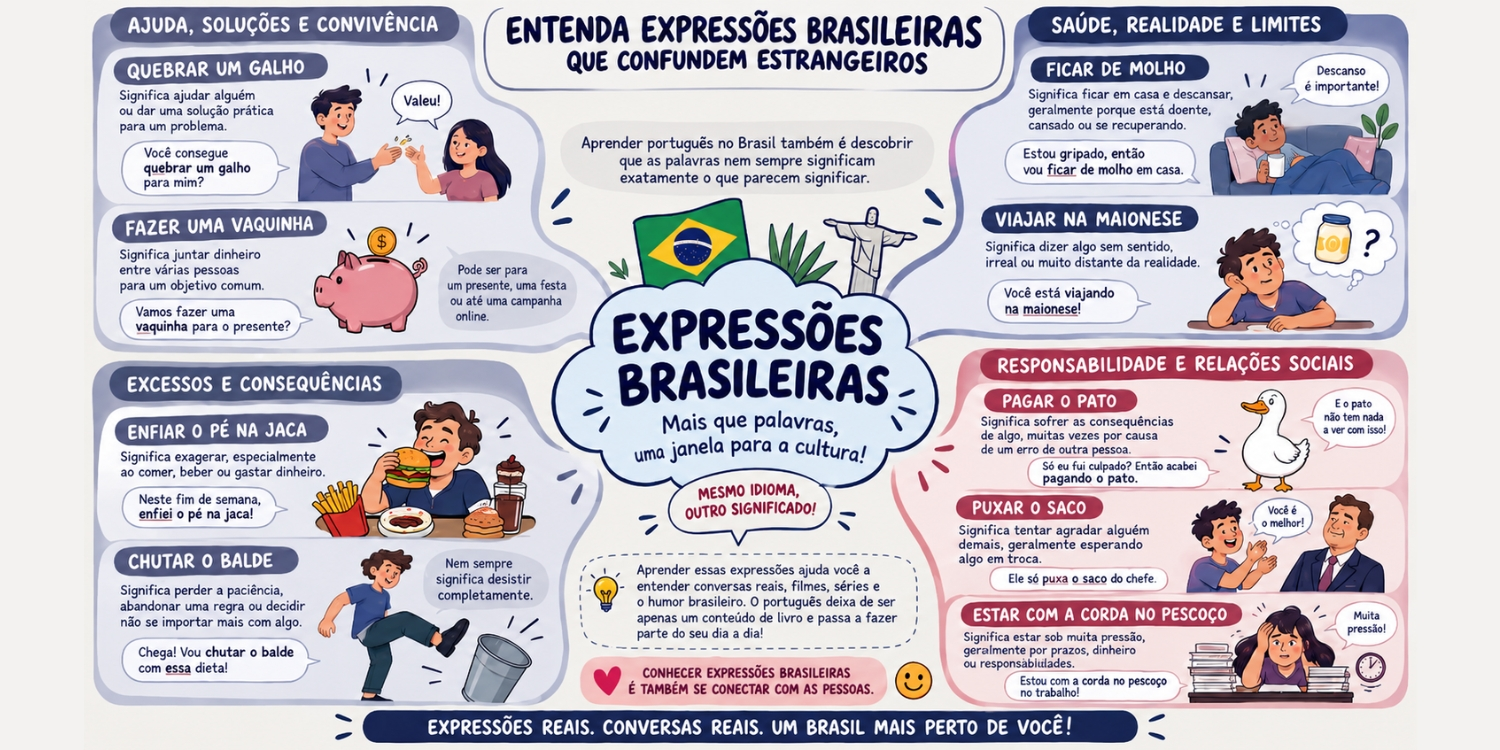
Learning Portuguese in Brazil also means discovering that words do not always mean exactly what they seem to mean.
Anyone who starts learning Brazilian Portuguese quickly realizes that grammar is only part of the journey. In everyday conversations, Brazilians use expressions that can sound completely confusing when translated word for word.
For a foreigner, hearing phrases such as “quebrar um galho”, “ficar de molho” or “viajar na maionese” can be puzzling at first. But these are exactly the kinds of expressions that make Brazilian Portuguese more vivid, natural and deeply connected to the culture.
QUEBRAR UM GALHO
No trees are actually involved.
When someone asks “Você consegue quebrar um galho para mim?”, they are asking for help or for a practical solution to a problem.
The expression can also be used when something is not ideal, but works well enough for the moment. For Portuguese learners, this is a great example of how the real meaning of a sentence often goes far beyond the literal words.
FICAR DE MOLHO
It sounds like something related to cooking, but it is not.
Ficar de molho means to stay home and rest, usually because someone is sick, tired or recovering from something.
A person might say: “Estou gripado, então vou ficar de molho em casa.” In English, the meaning would be close to “I have the flu, so I’m going to stay home and rest.”
The literal translation may sound strange, but to a Brazilian, the expression feels completely natural.
VIAJAR NA MAIONESE
One of the most curious expressions in Brazilian Portuguese.
When someone is “viajando na maionese”, it means they are saying something unrealistic, confusing or completely disconnected from reality.
It is a very informal expression and is commonly used in everyday speech. This is exactly the type of phrase that may never appear in the first chapters of a textbook, but can show up often in real conversations.
ENFIAR O PÉ NA JACA
An unusual image used to talk about going too far.
This expression is used when someone overdoes something, especially when eating, drinking or spending money.
After a weekend full of restaurants and desserts, for example, a Brazilian might say: “Enfiei o pé na jaca.”
For foreigners learning Portuguese, expressions like this can make conversations easier to follow and reveal the humor and creativity behind Brazilian speech.
PAGAR O PATO
And the duck has nothing to do with it.
Pagar o pato means to suffer the consequences of a situation, often because of something someone else did.
Imagine an entire team makes a mistake, but only one person is blamed. That person may say they ended up “pagando o pato.”
It is another example of how Brazilian Portuguese uses vivid images to express everyday situations in a memorable way.
PUXAR O SACO
An informal expression that is very common in Brazil.
When someone “puxa o saco” of another person, they are trying too hard to please them, usually because they expect something in return.
You may hear this expression at work, at school or even among friends. For Portuguese learners, understanding the tone is just as important as understanding the words, because this phrase usually carries a negative or ironic meaning.
ESTAR COM A CORDA NO PESCOÇO
An expression used when someone is under a lot of pressure.
To say that someone is “com a corda no pescoço” means that they are in a difficult situation, often related to deadlines, money or responsibilities.
A professional with several urgent tasks, for example, might use this expression to say they are under intense pressure.
Again, Brazilian Portuguese turns an abstract feeling into a very visual image.
DAR COM A LÍNGUA NOS DENTES
When a secret does not stay secret for long.
This expression means to reveal something that was supposed to remain private.
If someone receives confidential information and immediately tells another person, a Brazilian might say that they “deu com a língua nos dentes.”
Expressions like this help learners understand not only vocabulary, but also the informal tone of real Brazilian conversations.
CHUTAR O BALDE
It does not always mean giving up completely.
Chutar o balde can mean losing patience, abandoning a rule or simply deciding not to care anymore about a situation.
Someone may “kick the bucket” with a diet, a job or a personal commitment, although the Brazilian meaning is different from the English expression “kick the bucket.”
This is why context matters so much when learning Brazilian Portuguese.
FAZER UMA VAQUINHA
A very Brazilian expression for a very common situation.
Fazer uma vaquinha means collecting money from several people to pay for something together.
It may be used to buy a gift, organize a party or help someone financially. Today, the expression is also commonly used for online fundraising campaigns.
For a foreigner, the literal image may sound funny, but in Brazil the expression is completely normal.
WHY ARE THESE EXPRESSIONS IMPORTANT FOR PORTUGUESE LEARNERS?
Because speaking a language well means much more than knowing grammar and vocabulary.
A person may understand verb conjugations and sentence structure and still struggle to follow a conversation between Brazilians. That happens because spoken Portuguese is full of idiomatic expressions, humor, cultural references and informal ways of communicating.
Learning these expressions helps foreigners understand real conversations, social interactions, videos, TV shows and professional environments with much more confidence.
Over time, Portuguese stops feeling like something learned only from a book and starts becoming part of everyday life.
PORTUGUESE CLASSES FOR FOREIGNERS IN PIRACICABA AND ONLINE
Learning Portuguese in context makes a real difference.
At D’Accord Idiomas, we offer in-person Portuguese for foreigners in Piracicaba for students who want direct contact with the teacher, more interaction and a closer learning experience.
We also offer an online Portuguese course for students worldwide, which is ideal for anyone who lives in another city or country, travels frequently or simply prefers the flexibility of studying from home.
Our classes focus not only on grammar and vocabulary, but also on listening, speaking, pronunciation and real-life communication. Brazilian expressions, cultural differences and natural ways of speaking are part of the learning process.
UNDERSTANDING PORTUGUESE ALSO MEANS UNDERSTANDING HOW BRAZILIANS COMMUNICATE
Knowing words is important, but understanding what lies behind them changes the entire learning experience. When expressions such as “quebrar um galho” or “ficar de molho” stop sounding strange, it means the language is starting to feel natural.
If you are looking for in-person Portuguese for foreigners in Piracicaba or prefer an online Portuguese course for students worldwide, talk to the D’Accord Idiomas team. Tell us your current level, your goals and your availability, and we can guide you toward the most suitable learning format.
Learning Portuguese is not only about understanding the language. It is also about understanding the Brazilian way of thinking, speaking and connecting with people.